|
Jewish London, Historical Places and Events
The history of London's Jewish community from 1066 until the present, brought to life under the guidance of a Blue Badge* guide at the sites where it unfolded by entrée to houses, synagogues, museums, libraries, buildings famous and secret, lectures and social events, panoramic tours, country excursions and walks on foot.
Highlights range from the medieval Jewish quarter of the city of Lincoln, the homes of Freud and the Rothschilds, a presentation on illuminated Jewish manuscripts by their curator at the British Library to the cutting edge Saatchi Gallery's new location in the Edwardian splendour of County Hall.
In an article on July 4, 2003 entitled "Signs of the Thames" the New
York Jewish Week's critic characterises the tour as "perhaps the most
encompassing" he has "described in 30 years of travel writing."
> Historical Background
The Jews of the United Kingdom never suffered the dire fate of their
European brethren, brought about by 19th century pogroms and 20th
century fascism. They were never confined to ghettos nor hounded as
society’s outcasts. Yet England saw the earliest blood libel
accusations in Europe and was the first to expel its entire Jewish
population. The community had arrived from France in the wake of
William the Conqueror and prospered with a fair degree of toleration by
the church and freedom of movement under the protection of the king. In
the 13th century its usefulness as a source of crown revenue became
exhausted by increasing restrictions on these freedoms and extortionate
demands to finance wars and other royal extravagances. The decimation
of the community was accompanied by acts of violence by local
populations and, for the most part, false, charges of criminal
activity. In 1290 Edward I ordered the expulsion, from which time tiny
communities of mostly Sephardic Jews survived as “New Christians” until
a quarrel among them blew their cover and caused a second expulsion, by
James I, in 1609. Less than 50 years later, when the combination of
civil war, revolutionary ideas of equality and freedom of religion and
expression, a plethora of religious and political sects, some with the
desire to welcome Jews into their midst in order to convert them,
enabled Oliver Cromwell to clear the way in 1656, for the
“resettlement” of Jews in England.
The new community, consisting mostly of merchants of Sephardic origin
from Amsterdam, settled in the north-east corner of the historic and
financial centre of London, known as the City, opening its first
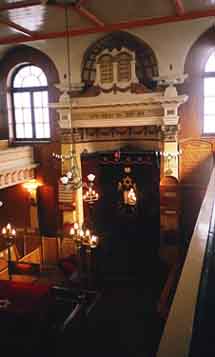
custom-built synagogue in a street named Bevis Marks in 1701. From
there it spread beyond east into Spitalfields and Whitechapel, where it
was augmented by less skilled co-religionists fleeing persecution and,
often, destitution, in the Rhineland, Poland and Russia. The 18th and
19th centuries are marked both by the establishment of many educational
and philanthropic organizations for their care as well as total, though
gradual, emancipation and the spectacular success of some of the
benefactors. The political, economic and cultural life of the country
was consequently enhanced by such luminaries of the Jewish community as
Nathan Mayer Rothshild and his descendants, Moses Montifiore and Prime
Minister Benjamin Disraeli, who, though converted to Christianity, was
still regarded as a Jew. Into this community came Chaim Weitzman,
Sigmund Freud and many others, as well as the reluctant Karl Marx.
Among its prominent current members are advertising mogul Charles
Saatchi, painter Lucian Freud, directors Sam Mendes and Jonathan
Miller, playwright Harold Pinter, actor Anthony Sher, Conservative
party leader Michael Howard, Lord Chief Justice Woolf, and new bane of
the establishment, Ali G.
The itinerary, scheduled as far as possible in chronological
sequence, brings you into contact with this unique and colourful
history. Each day is a carefully balanced mixture of touring, site
visits and social or educational events.
click each day on the left to immerse yourself in a detailed and illustrated view of the day-by-day program.
|